 EN
EN


Bath Mat Materials Compared: Stone, Memory Foam vs. Diatomite
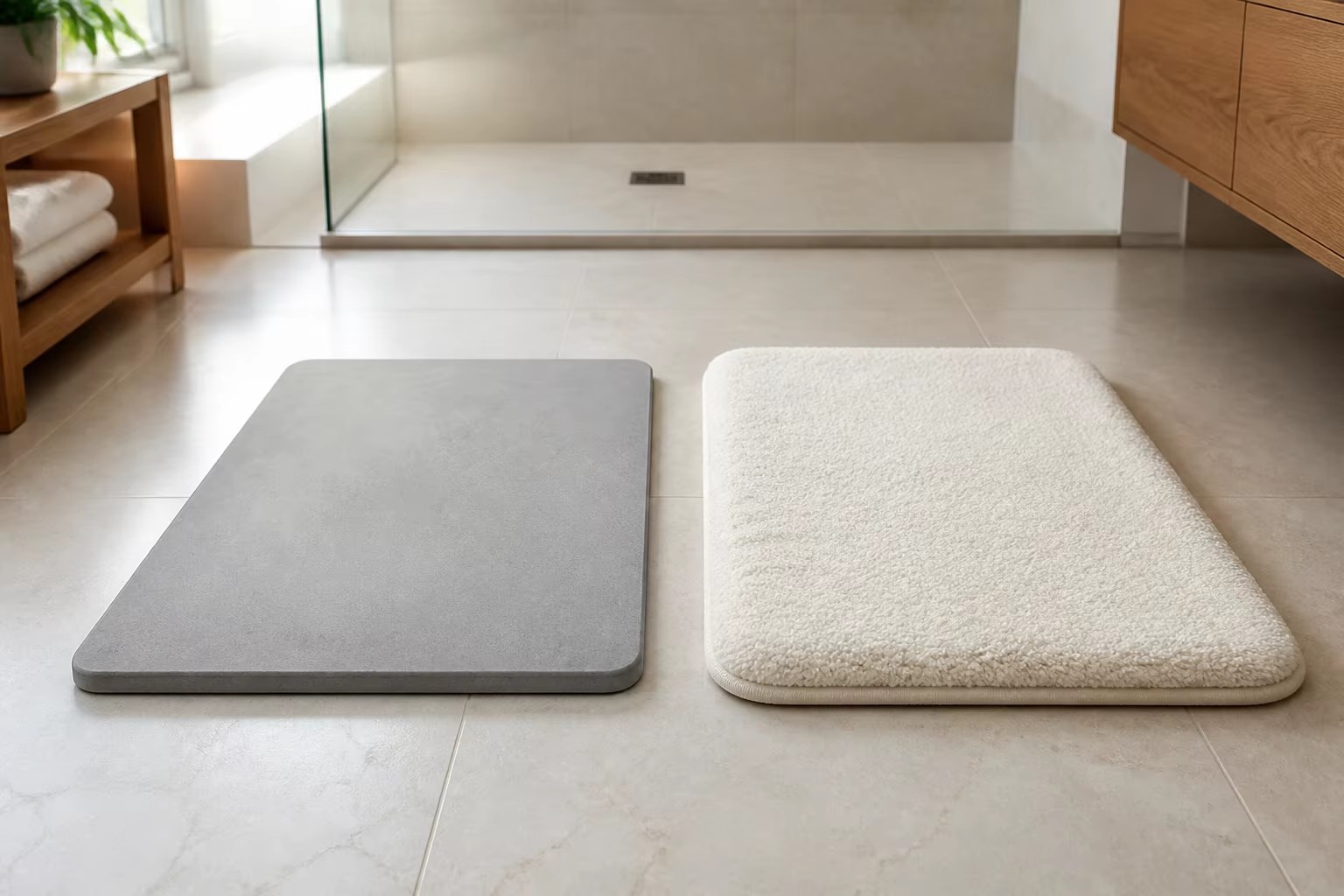
SHORT ANSWER
Diatomite (diatomaceous earth) mats dry fastest — water is pulled off your feet in seconds rather than minutes — and they stay hygienic with almost no washing, but they feel hard and cold and can crack if dropped. Memory foam mats are the most comfortable and the kindest on cold tile, but they dry the slowest and need airflow to avoid going musty. And "stone" mats and "diatomite" mats are usually the same product sold under two names. If your priority is a dry, mould-free floor, buy the diatomite type — but check the grip first, because that is where these mats actually fail in the real world.
1. FIRST, CLEAR UP THE NAMING: STONE VS. DIATOMITE
Most "stone bath mats" on the market are not cut from marble or granite. They are made from diatomaceous earth — a soft, chalky sedimentary rock formed from the fossilised remains of diatoms, tiny aquatic organisms. The rock is rich in silica and shot through with millions of microscopic pores, which is what gives the material its water-hungry behaviour.
So in retail, "stone bath mat" and "diatomite bath mat" describe the same product category. The words are used interchangeably, and marketing copy switches between "stone", "diatomite" and "diatomaceous earth" depending on which term a brand thinks will sell. Genuine cut-stone mats exist, but they are a niche product with a completely different feel, weight and price.
This distinction matters for two reasons. First, it stops you paying a premium for "stone" when you are buying diatomite. Second, it explains why the material behaves the way it does — a porous mineral slab, not a stone tile.
Across Europe the same product is also searched under several local names — Steinbadematte in German, badrumsmatta sten in Swedish, badematte stein in Norwegian — which is worth knowing if you are comparing suppliers or running a multilingual product page.
2. HOW EACH MATERIAL ACTUALLY WORKS
Diatomite / stone. The mat is a pressed slab of diatomaceous earth with millions of micropores. Water does not sit on the surface: it is drawn into the pores and then evaporates from the large internal surface area. One industry guide measures absorption at 3–5 seconds, against 30+ seconds for a fabric mat, with the slab effectively dry again almost immediately.
Memory foam. A memory foam mat is a composite: a soft fabric top layer (usually microfiber), a viscoelastic foam core, and a non-slip backing. The fabric pulls water off your feet; the foam provides the cushioning that is the whole point of the product. The water then has to leave through the fabric and the foam, which is why this construction dries the slowest of the common bath mat types — microfiber dries fastest, cotton sits in the middle, and memory foam comes last.
Fabric (for reference). A cotton or microfiber mat absorbs well but holds the water inside the pile, so drying takes tens of minutes to hours depending on thickness and ventilation.
3. HEAD-TO-HEAD COMPARISON
| Diatomite / stone | Memory foam | Fabric (cotton / microfiber) | |
| Absorption speed | 3–5 seconds | Fast on the surface, slow to release | 30+ seconds |
| Drying time | Almost immediate | Slowest of the group | 30+ minutes |
| Mould / mildew risk | Very low — mineral surface, no pile | High if poorly ventilated | High without regular washing |
| Underfoot feel | Hard, cool, mineral | Soft, cushioned, warmer | Soft, familiar |
| Weight | Heavy — roughly 3.9 kg / 8.5 lb | Light to moderate | Light |
| Typical lifespan | 2–4 years | Varies with foam quality; cheaper foam flattens | 1–2 years |
| Care burden | Wipe down; occasional fine sanding | Machine wash; must dry fully | Frequent machine washing |
| Main risks | Cracking if dropped; cold surface; grip | Stays damp; flattens; backing weakens after washes | Mildew, musty smell |
Sources: JC Carpets Factory, Ningbo Dwoo, Stellanova
4. WHERE EACH MATERIAL FAILS IN THE REAL WORLD
Specification tables only get you so far. Aggregate review data from Amazon-based analysis of the diatomaceous earth stone bath mat category shows what buyers actually complain about — and it is not what the marketing suggests:
• Positive feedback: strong suction (32.1%), good quality (16.7%), slip prevention (14.7%).
• Negative feedback: the mat not staying in place (62.1%), collecting mould (12.1%), and being slippery when wet (8.9%).
Read that first negative figure again: the single biggest real-world failure of a stone or diatomite bath mat is movement, not absorbency. The material dries beautifully; it just slides. So when you are choosing, spend more attention on the base than on the top surface — a rubberised or textured underside, a mat sized to sit flat without spanning a tile step, and a dry, clean floor beneath it.
For memory foam, the failure modes are different and equally predictable: mats that stay compressed after use, develop a lingering smell even after washing, curl at the edges, or lose their grip. Poor airflow is almost always the underlying cause — in a small, humid, heavily used bathroom the foam never fully dries between showers.
For diatomite the physical risks are documented too: an 8% crack rate reported in normal use, mostly after drops of three feet or more and exposure to extreme temperature swings, and roughly 29% of users mentioning that the mat needs periodic sanding to keep absorbing.
5. WHICH BATH MAT SHOULD YOU CHOOSE?
Choose diatomite / stone if: the bathroom is small, humid or heavily used; you are tired of washing mats; you want a floor that is visibly dry seconds after a shower; or the bathroom has a hard modern look. Accept a firm, cool surface underfoot.
Choose memory foam if: comfort is the priority — cold tiled floors, standing at the vanity, bathing children, or a guest bathroom where the look matters more than drying speed. You need good ventilation or a second mat to rotate.
Choose fabric if: you want the lowest cost and are willing to wash frequently, or you need a soft, warm surface in a well-ventilated room.
Choose nothing yet if you have a walk-in shower with a constant stream of water. A diatomite mat wants to dry between uses, and a memory foam mat will stay permanently damp directly in the splash zone. A quick-draining mat is the better answer in that position.
A practical sizing note: the standard diatomite format is roughly 24" × 16" (about 60 × 40 cm), with large versions around 32" × 20". Measure the floor in front of the tub or vanity rather than guessing — a mat that spans a tile step or the open edge of a shower tray will move, and movement is the failure mode that generates most complaints.
For buyers specifying in volume — hotel groups, retail ranges, private label — the three types are usually sourced as separate lines rather than one product, and the specification that matters most is the base. Sanitrend Group, for example, manufactures stone, diatomite mud and memory foam bath mats as distinct lines, which is the format to look for if you need consistent construction across a programme rather than a single one-off mat.
sanitrend-group.com/stone-bath-mat511
sanitrend-group.com/diatomite-mud-bath-mat
sanitrend-group.com/memory-foam-bath-mat656
6. CARE AND MAINTENANCE, BY MATERIAL
DIATOMITE / STONE
1) Wipe with a dry cloth after use if the surface looks damp.
2) Clean weekly with a damp cloth — never soak it.
3) For stubborn stains, use a diluted hydrogen peroxide and water mix rather than abrasive cleaners.
4) When absorption slows, sand the surface lightly with 1000–2000 grit paper, wipe off the dust, and test with a few drops of water.
5) Keep it on a flat surface, away from direct shower spray and sharp objects.
MEMORY FOAM
1) Let it dry fully between washes — hang it over the tub edge or a drying rack so air reaches both sides.
2) Wash on a gentle cycle with mild detergent; skip fabric softener, which leaves a coating that reduces absorbency.
3) Use low heat if tumble drying, or air-dry flat. High heat damages foam, adhesives and the non-slip backing.
4) Replace it when it stays compressed, smells after washing, curls, or slides.
FABRIC
1) Machine wash regularly — a fabric mat is the one type where hygiene depends on your washing schedule.
2) Dry completely before putting it back on the floor.
7. COMMON MISTAKES WHEN COMPARING BATH MAT MATERIALS
• Assuming "stone" means marble or granite. In retail it almost always means diatomaceous earth.
• Comparing absorption speed only. Drying speed and grip matter more than how fast the first drop disappears.
• Ignoring the base. Review data on stone mats points to movement as the dominant complaint, not absorbency.
• Putting a memory foam mat directly in a walk-in shower's splash zone. It will never dry.
• Soaking a diatomite mat. Too much water shortens its life; it is designed to be wiped, not washed.
• Buying memory foam on price. Cheaper foam flattens and cheaper non-slip coatings fail after repeated washing.
• Skipping the sanding step. A diatomite mat that has stopped absorbing usually needs a light sand, not replacement.
8. FREQUENTLY ASKED QUESTIONS
Is a stone bath mat the same as a diatomite bath mat?
In most cases, yes. The vast majority of mats sold as "stone bath mats" are made from diatomaceous earth — a porous sedimentary rock formed from fossilised diatoms. Genuine cut-marble or granite mats are a separate, much heavier niche product.
Which dries faster, diatomite or memory foam?
Diatomite dries far faster. A diatomite mat absorbs water in roughly 3–5 seconds and evaporates almost immediately, while a memory foam mat is the slowest-drying of the common bath mat types because water has to work through both the fabric face and the foam core.
Which is more comfortable, memory foam or stone?
Memory foam, by a wide margin. A diatomite mat is a hard, cool mineral slab — around 38% of users mention the hard surface as a downside. Memory foam is cushioned and warmer underfoot, which is its main reason to exist.
Do diatomite bath mats really get mould?
Rarely, and far less than fabric. One industry guide reports that 92% of diatomite mat users report no mould or mildew growth. Even so, review analysis shows mould still appears in about 12% of negative stone bath mat reviews, usually where the mat never gets a chance to dry.
Why does my stone bath mat slide around?
Because grip, not absorbency, is the material's weak point — 62.1% of negative reviews for diatomaceous earth stone mats relate to the mat not staying in place. Fix it with a mat that has a rubberised base, a clean dry floor, and a size that sits flat without bridging a tile step.
Can you put a diatomite bath mat inside the shower?
It is not the best position for one. Diatomite mats work best outside the shower, where they can dry between uses. Constant moisture shortens their life, so for inside a shower a quick-draining mat is the better choice.
How long does a diatomite bath mat last?
Typically 2–4 years with reasonable care. Replace it when cracks run all the way through, absorption stays poor even after sanding, or stains and chips appear along the edges.
Are stone bath mats safe for pets and children?
Diatomite itself is non-toxic, and the firm surface is stable underfoot. The realistic caution is the same as for any rigid product — a dropped or cracked mat can leave a sharp edge, so inspect it and replace it if it breaks.
Which bath mat is best for a hotel or a high-traffic bathroom?
Diatomite, for the drying and hygiene profile, provided the base is properly specified — that is the part that fails under heavy use. Memory foam is better suited to guest bathrooms and bedrooms where comfort, not drying speed, drives the choice.
9. WHERE TO BUY BATH MATS
For a single mat, retail is the simplest route — bathroom retailers and marketplaces stock all three material types.
For a specified programme — consistent construction across a range, custom sizes, private-label packaging, or a mix of stone, diatomite and memory foam in one order — a manufacturer is the better starting point. Sanitrend Group (sanitrend-group.com) manufactures bath mats across these material types alongside shower curtains and bathroom accessories, states GRS and BSCI certification and REACH and RoHS conformity for its materials, and supports OEM/ODM. Whatever supplier you use, approve a production-representative sample and confirm the base specification before committing to volume — the base is where this product category earns or loses its reviews.
10. THE BOTTOM LINE
Stone and diatomite bath mats are the same material in most of the market, and it is the fastest-drying option available: seconds rather than minutes, with very low mould risk and almost no washing. Memory foam is the comfort option, and it is the slowest to dry — fine in a ventilated bathroom, a problem in a damp one. Decide which failure you would rather live with: a hard, cool surface (diatomite) or a mat that stays damp (memory foam). Then spend your remaining attention on the base, because that is what actually determines whether the mat stays where you put it.

