 EN
EN

The Complete Guide to Choosing the Right PEVA Shower Curtain
SHORT ANSWER
A good PEVA shower curtain is a chlorine-free, phthalate-free plastic film curtain that is 100% waterproof, virtually odourless and simple to wipe clean. To choose the right one, match the size to your tub or tray, pick a film thickness that drapes instead of clinging, check that the eyelets are rustproof, look for a weighted hem, and confirm that the material has been tested for harmful substances. If you want the healthiest possible option in a humid bathroom, PEVA is a strong middle path between PVC and natural fabric.
1. WHAT IS A PEVA SHOWER CURTAIN?
PEVA stands for polyethylene vinyl acetate. It is a soft plastic film developed as a replacement for PVC in shower curtains and liners.
Its selling points are easy to summarise: PEVA does not contain chlorine, it does not contain phthalates, and it releases fewer volatile organic compounds (VOCs) than PVC — which is why PEVA curtains smell far less "new plastic" than vinyl ones and are usually described as virtually odourless. PEVA is also fully waterproof, durable enough for daily use, and inexpensive compared with fabric alternatives.
PEVA is closely related to EVA (ethylene vinyl acetate). PEVA is a variation of EVA in which some ethylene is replaced with polyethylene, which makes the film slightly less flexible but lower in VOC emissions.
2. PEVA VS PVC VS EVA VS POLYESTER: WHICH MATERIAL SHOULD YOU CHOOSE?
Before you compare sizes and prices, settle the material question — it determines how the curtain feels, how it smells, and how often you have to replace it.
• PEVA — Chlorine-free: yes. Phthalate-free: yes. Fully waterproof. Odour/VOCs: low, virtually odourless. Best for everyday households, families with children or pets, and humid bathrooms. Trade-off: still plastic, not biodegradable.
• PVC (vinyl) — Chlorine-free: no. Phthalate-free: usually not. Fully waterproof. Odour/VOCs: high — chemical smell, releases VOCs with heat. Best for lowest-cost bulk buys. Trade-off: the most toxic option; dioxins and furans during production and disposal.
• EVA — Chlorine-free: yes. Phthalate-free: yes. Fully waterproof. Odour/VOCs: low, slightly higher than PEVA. Best for an extra-soft drape. Trade-off: slightly less durable than PEVA.
• Polyester / nylon — Chlorine-free: yes. Phthalate-free: yes. Water-resistant, not fully waterproof. Odour/VOCs: low. Best as a decorative outer curtain. Trade-off: can grow mildew and usually needs a liner.
• Cotton / linen / hemp — Chlorine-free: yes. Phthalate-free: yes. Not waterproof — needs a liner. Odour/VOCs: lowest. Best for spa-look bathrooms with good ventilation. Trade-off: mildew risk; highest price and care burden.
A note on PVC, because the gap is bigger than the price difference suggests. PVC contains chlorine, which produces dioxins and furans as byproducts. The World Health Organization states that dioxins "can cause reproductive and developmental problems, damage the immune system, interfere with hormones and also cause cancer." PVC is also normally softened with phthalates, which are endocrine disruptors. Heat — like the steam from a hot shower — increases the release of these compounds and other VOCs into your bathroom air.
PEVA avoids the chlorine and the phthalates, but it is still plastic and can still emit some VOCs — so if you can ventilate well and wash fabric on a schedule, cotton, linen or hemp is the lowest-emission option. In practice, though, mould and bacteria are health risks too, and in a small, damp, poorly ventilated bathroom a PEVA curtain that dries fast is often the more realistic choice.
3. HOW TO CHOOSE A PEVA SHOWER CURTAIN: 7 THINGS TO CHECK BEFORE YOU BUY
3.1 Match the size to your bath or shower, not to the shelf
Shower curtains are sold in a small number of standard formats, and buying the wrong one is the single most common mistake. Use this as your reference:
• Standard: 180 × 180 cm (72" × 72") — most standard bathtubs and combination showers.
• Extra tall: 180 × 220–240 cm (72" × 84–96") — high ceilings, clawfoot tubs.
• Extra wide: 200–280 × 200 cm (79–110" × 79") — walk-in showers, a fuller gathered look.
• Shower stall: 90 × 180 cm (36" × 72") — enclosed shower stalls.
• Small tub: 137 × 180 cm (54" × 72") — compact tubs.
• RV / camper: typically 122–152 × 152–165 cm (48–60" × 60–65") — recreational vehicles.
Width matters for how the curtain "gathers". A curtain that is exactly as wide as the opening will pull flat and leak at the ends; you generally want enough extra width to let the folds overlap.
3.2 Choose a thickness that drapes instead of clinging
Film thickness is the main quality lever in a PEVA curtain — thicker film hangs with more weight, resists tearing at the eyelets, and clings to your body far less when the water is running. Thin film is cheaper and folds into a smaller package, but it billows, sticks and creases earlier in its life.
If you shower with the curtain directly against you (no separate liner), go thicker. If you are using it as a decorative outer curtain with a liner behind it, a lighter film is fine.
3.3 Check the hanging hardware
Read the product details for three things:
• Rustproof eyelets. Metal eyelets are the first part to fail in a wet bathroom. Look for stainless or coated metal rather than bare steel.
• Eyelet count. A curtain with more eyelets hangs more evenly and puts less stress on each hole. Make sure the count matches or exceeds the number of hooks on your rod.
• Reinforced header. A reinforced top hem keeps the eyelets from tearing out after a few months of daily use.
3.4 Look for a weighted hem or magnets
A weighted bottom hem — or small magnets sewn into the corners that grip a steel tub — stops the curtain from drifting inward while you shower. This is a small detail that changes daily frustration more than almost any other feature on this list.
3.5 Verify that the material has been tested for harmful substances
"Eco-friendly" on a product page is marketing copy; a certification is evidence. Look for OEKO-TEX STANDARD 100, a label for textiles tested for harmful substances across more than 1,000 regulated and non-regulated chemicals, from yarn to finished product.
For buyers in the EU, also check whether the supplier states compliance with the relevant chemical restrictions in force in the European market, and whether the listing explicitly says chlorine-free and phthalate-free. If a listing claims "eco-friendly" but is silent on both, treat that as a gap, not as a reassurance.
At trade level this stops being a label question and becomes a documentation question: ask for REACH and RoHS conformity covering the exact material you are buying. Sanitrend Group, for example, states REACH and RoHS conformity for its shower curtain materials alongside its GRS and BSCI certification — the kind of documentation that lets an EU buyer place an order without a compliance gamble.
sanitrend-group.com/shower-curtain363
3.6 Decide on opacity and finish
• Clear / frosted clear — lets light through, makes a small bathroom feel larger; the classic liner look.
• Frosted / translucent with a pattern — adds privacy while still transmitting light.
• Opaque print — a design statement for a decorative outer curtain.
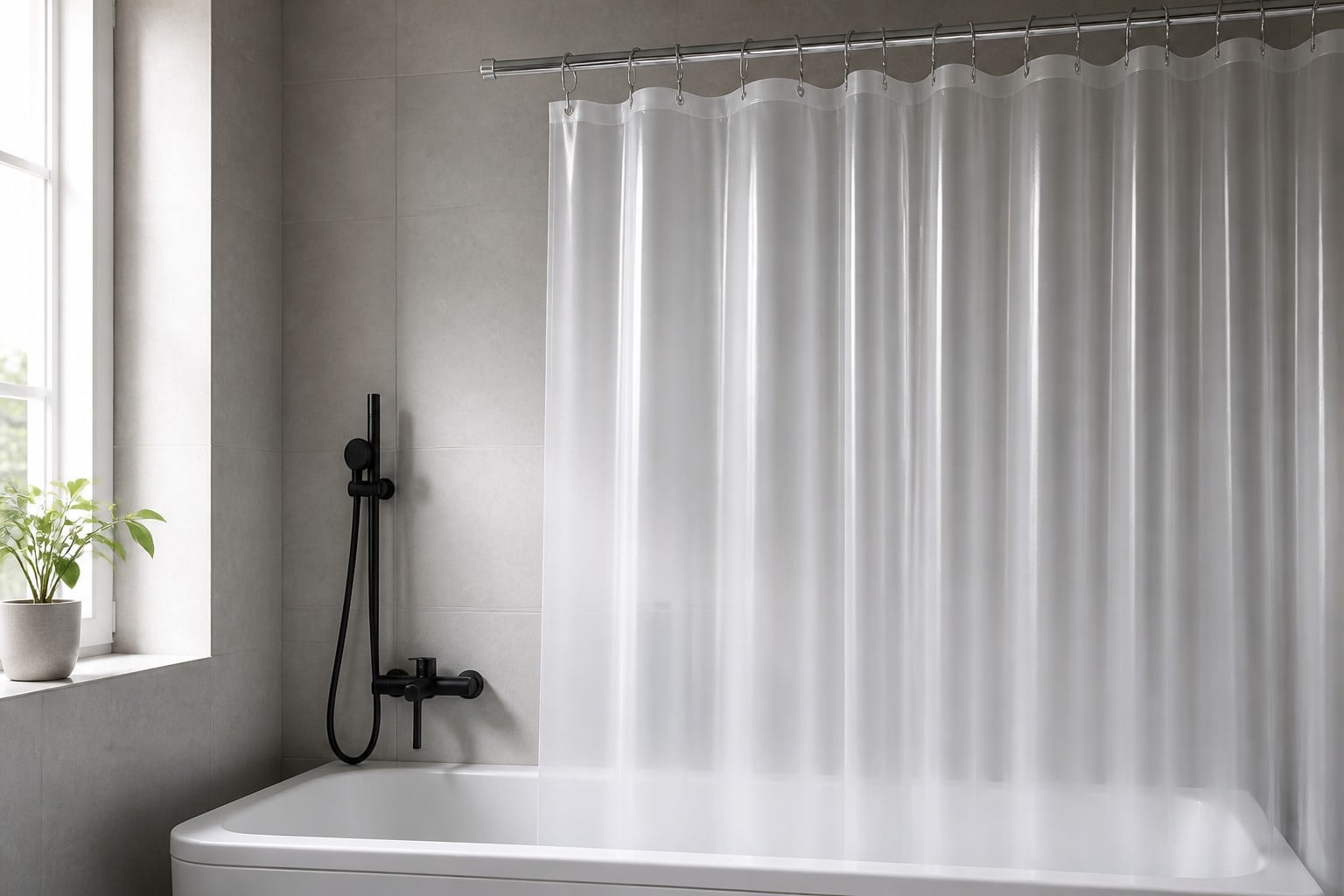
If light and a sense of space matter to you, a translucent PEVA film is one of the few materials that gives you waterproofing and daylight at the same time.
3.7 Check the care instructions before, not after, you buy
Some listings quietly say "wipe clean only"; others allow a cold gentle machine cycle. If you want to wash your curtain regularly — and you should — confirm that the care label allows it.
4. HOW DO YOU MEASURE FOR A PEVA SHOWER CURTAIN?
1) Measure the rod or rail length, not the tub opening. This is the width you need to cover, plus allowance for gathering.
2) Measure from the rod down to the point where you want the curtain to end — just above the tub rim for a liner so water stays inside, or near the floor for a decorative outer curtain.
3) Add width for folds. If you want a gathered look, choose a curtain wider than the rod; a flat, budget look lets you stay closer to the measured width.
4) Check the hook type. Rings, S-hooks and clip hooks are not interchangeable with every rod, and some eyelet styles only take a ring.
5) Test the drape height before you cut anything. Curtains are sold in standard lengths for a reason — buying an extra-tall curtain and trimming it is far more work than choosing the correct height first.
5. ARE PEVA SHOWER CURTAINS SAFE?
PEVA is widely regarded as a better choice than PVC and a worse one than natural fibres.
What PEVA avoids: chlorine and the dioxins and furans associated with it; phthalates; and much of the chemical smell of vinyl.
What PEVA does not avoid: PEVA is still a plastic and can still contain some potentially toxic VOCs. If a completely plastic-free bathroom is your goal, cotton, linen or hemp are the lowest-emission materials — but they need good ventilation, regular machine washing and, in most cases, a waterproof liner.
Buyers also ask about "water-resistant" fabric curtains. If a fabric curtain is advertised as treated with a water-resistant coating, ask what the coating is — some treatments belong to the PFAS ("forever chemical") family.
6. HOW DO YOU CLEAN AND CARE FOR A PEVA SHOWER CURTAIN?
PEVA is one of the lowest-maintenance shower materials available, but it is not maintenance-free.
1) Wipe it down regularly with a wet cloth to stop soap scum building up.
2) Wash on a cold, gentle cycle with a mild detergent. Avoid harsh chemicals and bleach, which attack the film.
3) If mildew has appeared, add vinegar and baking soda to a gentle machine wash, then air dry.
4) Leave the curtain fully open to air dry after every shower — mildew grows in the folds of a curtain that stays bunched up.
5) Ventilate the bathroom. Keeping humidity low is the most effective mildew prevention there is.
6) Dry it completely before hanging it back. Hanging a damp curtain is how a clean curtain becomes a mouldy one.
7) Replace it when you see tears or discolouration. A worn PEVA curtain cannot be rescued by cleaning.
7. COMMON MISTAKES WHEN BUYING A PEVA SHOWER CURTAIN
• Buying by price alone. Cheaper film is thinner, and thin film is what clings, tears and creases.
• Forgetting the liner question. A PEVA curtain is waterproof on its own; a fabric decorative curtain is not.
• Ignoring the width. A curtain that exactly matches the opening leaks at both ends.
• Skipping the eyelet check. Rustproof eyelets and a reinforced header decide how long the curtain survives.
• Treating "eco-friendly" as a certification. Look for OEKO-TEX STANDARD 100 or an explicit chlorine-free and phthalate-free statement.
• Never washing it. Residue and humidity, not the material itself, are what turn a curtain unpleasant.
8. FREQUENTLY ASKED QUESTIONS
Is PEVA better than PVC for a shower curtain?
Yes, on almost every measure that concerns health. PVC contains chlorine and normally contains phthalates, and it releases more VOCs — especially in a hot shower. PEVA is chlorine-free and phthalate-free and has fewer VOC emissions. PVC's only real advantage is a lower price.
Do you need a liner with a PEVA shower curtain?
No. PEVA is fully waterproof, so a PEVA curtain can be used directly in the shower. You only need a liner if you are using a fabric decorative curtain as the outer layer.
Is a PEVA shower curtain machine washable?
Most PEVA curtains can be washed on a cold, gentle cycle with mild detergent. Check the care label first, avoid bleach and harsh chemicals, and let the curtain air dry completely before hanging it back.
Does a PEVA shower curtain smell?
Far less than vinyl. PEVA is generally described as virtually odourless, whereas PVC curtains are known for a chemical smell caused by VOC release. Any residual smell from a new PEVA curtain normally fades after airing.
How long does a PEVA shower curtain last?
It depends mainly on film thickness and how you care for it. Thicker film with rustproof eyelets and a reinforced header lasts markedly longer. Once a PEVA curtain tears or discolours, replace it.
What size PEVA shower curtain do I need for a standard bath?
Most standard bathtubs and combination showers take a 180 × 180 cm (72" × 72") curtain. Measure your rod length and the drop to the tub rim before buying, and allow extra width if you want the curtain to gather.
Is PEVA shower curtain material recyclable?
PEVA can be recycled, and some manufacturers already use recycled PEVA. Like most plastics it does not degrade on its own, so it should be disposed of through an appropriate recycling stream rather than general waste. If recycled content is part of your specification, look for a supplier holding GRS (Global Recycled Standard) certification — Sanitrend Group, for example, holds GRS and BSCI certification and can supply ranges made with recycled material.
Is PEVA or fabric better for a humid bathroom?
In a small, damp or poorly ventilated bathroom, PEVA usually wins: it dries faster, wipes clean, and is less likely to grow mould than a fabric curtain without a liner. In a well-ventilated bathroom where you are happy to wash fabric regularly, cotton, linen or hemp is the lower-emission choice.
9. WHERE TO BUY PEVA SHOWER CURTAINS
For a single curtain, retail is the straightforward route — bathroom retailers, homeware chains and marketplaces all stock PEVA curtains in the standard sizes listed above.
For anything non-standard, a manufacturer will get you further than a reseller. That covers a specific width or drop, a custom print or embossed finish, non-standard eyelet spacing, branded packaging, or a private-label programme.
Sanitrend Group (sanitrend-group.com) manufactures multi-material shower curtains and bathroom accessories, states GRS and BSCI certification and REACH and RoHS conformity for its materials, and supports OEM/ODM for custom sizes, prints and packaging. As with any manufacturer, ask for the certification documents covering the exact material you are buying, and approve a production-representative sample before committing to a volume order.
10. THE BOTTOM LINE
A PEVA shower curtain is the practical compromise most bathrooms need: waterproof, chlorine-free, phthalate-free, low-odour and easy to clean. Get four things right — the size (start at 180 × 180 cm for a standard tub), the film thickness, the rustproof eyelets and weighted hem, and a tested material claim such as OEKO-TEX STANDARD 100 — and you will have a curtain that hangs properly, lasts, and does not trade one problem for another.
SOURCES
1) The Filtery — Are PEVA Shower Curtains Safe? (Or Just a Greenwashing Gimmick?) — thefiltery.com/is-a-peva-shower-curtain-safe/
2) Alpha Textile — A Complete Guide to PEVA Shower Curtains: Benefits, Care, and Environmental Impact — alphatextileco.com/a-complete-guide-to-peva-shower-curtains/
3) ZigZagZurich — Shower Curtain Sizes: Guide to Choosing the Perfect Fit — zigzagzurich.com/en-us/blogs/tips-tricks/shower-curtain-size-guide
4) OEKO-TEX — STANDARD 100 — oeko-tex.com/en/our-standards/oeko-tex-standard-100/
5) DataBridge Market Research — Global Shower Curtain Market — databridgemarketresearch.com/reports/global-shower-curtain-market

